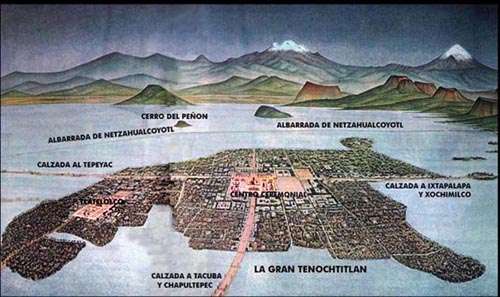
Tenochtitlan was an Aztec city located on an island in Lake Texcoco, in the Valley of Mexico. Founded in 1325, it was the center of a prosperous Aztec society until it was conquered by Spanish Conquistadors led by Hernan Cortes. Today the ruins of Tenochtitlan are located near Mexico City, Mexico.
Tenochtitlan covered an estimated 8 to 13.5 square kilometers, situated on the western side of the shallow Lake Texcoco. It was connected to the mainland by causeways leading north, south, and west of the city. These causeways were interrupted by bridges that allowed canoes and other traffic to pass freely. The bridges could be pulled away if necessary to defend the city. The city itself was interlaced with a series of canals, so that all sections of the city could be visited either on foot or via canoe.
The city was divided into four neighborhoods. divided by channels used for transportation, with wood bridges that were removed at night.
Each neighborhood had some specialty in arts and craft. When each neighborhood offered some celebration, they tried to outdo the others.
In the center of the city were the public buildings, temples and schools. Inside a walled square, 300 meters to a side, was the ceremonial center. There were about 45 public buildings including: the Templo Mayor, the temple of Quetzalcoatl, the ball game, the tzompantli or rack of skulls, the temple of the sun, the platforms for the gladiatorial sacrifice, and some minor temples. Outside was the palace of Montezuma with 100 rooms, each one with its own bath, for the lords and ambassadors of allies and conquered people. Also located nearby was the cuicalli or house of the songs, and the calmecac.
The city had a great symmetry. All constructions had to be approved by the calmimilocatl, a functionary in charge of the city planning.
The palace of Montezuma also had two houses or zoos, one for birds of prey and another for other birds, reptiles and mammals. About three hundred people were dedicated to the care of the animals. There was also a botanical garden and an aquarium. The aquarium had ten ponds of salt water and ten ponds of fresh water, containing fish and aquatic birds. Places like this also existed in Texcoco, Chapultepec, Huaxtepec (now called Oaxtepec) and Texcotzingo.
It was reported that the city also had beggars (only crippled people were allowed to beg), thieves and other criminals. At night, in the dark alleys one could find all types of crimes and dangers.
The Spanish Conquistadors were amazed to find latrines in private houses and a public latrine in the tiyanquiztli and main streets. Small boats went through the city collecting garbage, and excrement was collected to be sold as fertilizer. About 1,000 men were dedicated to cleaning the city's streets.
For public purposes, and to be able to set the pace of official business, trumpets were sounded from the tops of the temples six times a day: at sunrise, later on in the morning, at midday, again in the mid-afternoon, after sunset, and at midnight.
A thriving culture developed, and the Aztec civilization came to dominate other tribes all around Mexico. The small natural island was perpetually enlarged as Tenochtitlan grew to become the largest and most powerful city in Mesoamerica. Commercial routes were developed that brought goods from places as far as the Gulf of Mexico, the Pacific Ocean and perhaps even the Inca Empire.
Spanish conquistador Hernán Cortés arrived in Tenochtitlan on November 8, 1519. At this time it is believed that the city was one of the largest in the world; compared to Europe, only Paris, Venice and Constantinople were larger. Some of the conquistadores had travelled as widely as Venice and Istanbul, and many said that Tenochtitlan was as large and fine a city as any they had seen.
The most common estimates put the population at over 200,000 people, although some popular sources put the number as high as 350,000. Cortés and his men, aided in particular by the Confederacy of Tlaxcala, eventually conquered the city on August 13, 1521, after a siege that lasted months in which much of the city was destroyed.
Cortés subsequently directed the systematic destruction and levelling of the city and its rebuilding, despite opposition, with a central area designated for Spanish use (the traza). The outer Indian section, now dubbed San Juan Tenochtitlan, continued to be governed by the previous indigenous elite and was divided into the same subdivisions as before, sans the Spanish area.
Some of the remaining ruins of Tenochtitlan's main temple, the Templo Mayor, were uncovered during the construction of a metro line in the 1970s. A small portion has been excavated and is now open to visitors. Mexico City's Zócalo, the Plaza de la Constitución, is located at the location of Tenochtitlan's original central plaza and market, and many of the original calzadas still correspond to modern streets in the city. The Aztec sun stone was located in the ruins. This stone is 4 meters in diameter and weighs over 20 tonnes. It was once located half way up the great pyramid. This stone calendar was made around 1470 CE under the rule of King Axayacatl, the predecessor of Tizoc, and is said to tell the Aztec history and prophecy for the future.